Snakes in Dreams Meaning in Islam: Ibn Sirin’s Guide
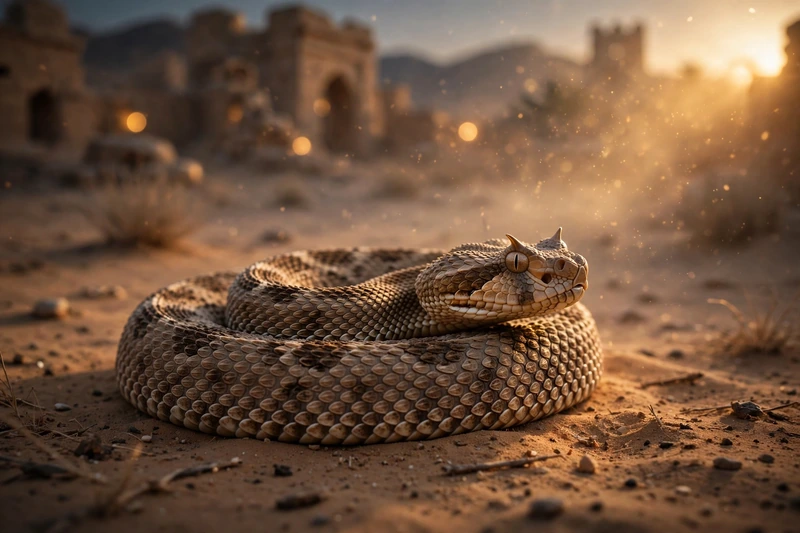 Quick answer: In the classical tradition of Muhammad ibn Sirin, a snake in a dream most commonly symbolizes an enemy or hidden hostility. Its size, color, and behavior reveal the enemy’s strength: killing the snake means victory, while a bite warns of harm from them. Scholars differ on details, and ultimate knowledge belongs to Allah alone.
The question of snakes in dreams meaning in Islam has one of the richest answers in any dream tradition. For over a thousand years, Muslim scholars have treated dream interpretation as a serious discipline with real principles, not as fortune-telling, and Muhammad ibn Sirin’s method still shapes how these dreams are read today.
This guide covers what the classical tradition actually says: the core principles, the most common scenarios, what colors change, and what Islam teaches you to do after a troubling dream. It is written for information, not as a religious ruling, and it keeps the tradition’s own cautions exactly where the scholars put them.
Important Note Before You Read
This guide summarizes the classical Islamic dream-interpretation tradition for informational purposes. It is not a religious ruling (fatwa). Islamic scholarship treats dream interpretation as a serious discipline with principles, not as fortune-telling, and scholars consistently emphasize three things: the dreamer’s personal circumstances matter enormously, interpretations legitimately differ among qualified scholars, and certain knowledge of any dream’s meaning belongs to Allah alone. If a dream troubles you, consult a knowledgeable, trustworthy scholar rather than relying solely on any article, including this one.
Who Was Ibn Sirin?

Muhammad ibn Sirin (653-729 CE) was a renowned early Muslim scholar of Basra, famous for his piety, his knowledge of hadith, and an extraordinary gift for interpreting dreams. His name became so closely associated with the field that the classical manual Muntakhab al-Kalam fi Tafsir al-Ahlam (Selected Words on the Interpretation of Dreams) is traditionally attributed to him, though scholars debate its exact authorship.
Later scholars built on his foundation, most notably Abdul Ghani al-Nabulsi (1640-1731), whose Ta’tir al-Anam fi Tafsir al-Ahlam systematized the tradition. The classical method draws on the Quran, the Sunnah, the Arabic language, and the dreamer’s own condition.
A famous Quranic precedent for dream interpretation itself is the story of Prophet Yusuf (Joseph), whose God-given ability to interpret dreams is narrated in Surah Yusuf (12:4-101), including his own childhood dream of eleven stars, the sun, and the moon prostrating to him. (read Surah Yusuf on Quran.com) This establishes, in Islamic thought, that dreams can carry real meaning, while also establishing that true interpretation is a gift, not a mechanical formula.
What Are the Core Principles of Islamic Snake Dream Interpretation?
Islamic dream interpretation reads a snake through five recurring principles: it usually represents an enemy or hidden hostility, its size and number measure the threat, its behavior reveals the nature of the enmity, the dreamer’s own response (fleeing, fighting, killing) shapes the outcome, and the dreamer’s personal context can change everything.
1. The snake as enemy. The dominant reading across the classical manuals: a snake represents an adversary, a hypocrite, or hidden hostility directed at the dreamer. This draws partly on the Quranic narrative in which the staff of Musa (Moses) becomes a serpent in the confrontation with Pharaoh’s magicians (Surah Al-A’raf 7:107-117; Surah Ta-Ha 20:65-70), placing the snake inside a contest between truth and falsehood.
2. Size and number measure the threat. A large snake suggests a powerful enemy; many snakes suggest multiple adversaries or widespread hostility. A small snake may indicate a weak enemy or a minor trouble that has not yet grown.
3. Behavior reveals the nature of the enmity. An attacking snake points to open hostility, a hidden snake to concealed plotting, and a snake that speaks gently to surprising words arriving from an unexpected quarter.
4. The dreamer’s response matters. Fleeing, fighting, killing, or taming the snake each carry distinct meanings. As a rule, overcoming the snake is positive.
5. Context is decisive. The same snake seen by a righteous person and by someone in a difficult spiritual state, in prosperity or in hardship, may be read differently. Classical interpreters always asked about the dreamer’s life before interpreting, which is why generic lists can only ever be a starting point.
What Do Common Snake Dream Scenarios Mean in Islam?
Questions about dream meaning in islam snake symbolism go back more than a thousand years, and the classical manuals return to the same handful of scenarios again and again. Most people looking up snake dreams meaning in islam want exactly this: what does my specific dream mean? The table below gives the quick version; the details that follow explain the reasoning behind each one.
| Scenario | Classical reading |
| Bitten by a snake | Harm reaching you from an enemy, matching the bite’s severity |
| Killing a snake | Victory over an enemy; the end of a hostility |
| Snake entering the house | An enemy with access to your private or family life |
| Snake speaking gently | Unexpected benefit or kind words from an unlikely source |
| Many snakes | Multiple enemies, or anxieties multiplying |
| Eating snake meat | Gaining wealth or benefit from a defeated enemy |
| Snake in water | An enemy within your livelihood or social circle |
The species of the snake can add another layer for those who remember it clearly. Our guide to the different types of snakes in dreams covers cobras, pythons, and vipers in detail, though the classical Islamic manuals focus less on species and more on the snake’s size, color, and behavior.
Being Bitten by a Snake
A snake bite is generally read as harm reaching the dreamer from an enemy, with the severity of the harm matching the severity of the bite. The body part bitten can matter in some readings, as harm touching the area of life that part represents. Readers looking for the general symbolism of bites may also see our snake bite dream meaning guide.
Killing a Snake
The dream meaning in Islam of killing a snake is among the most consistently positive readings in the tradition: it generally signifies triumph over an enemy, the end of a hostility, or relief from a difficulty. Cutting a snake into pieces has been read as decisively ending an enmity, and some readings add that the dreamer may gain something from the defeated adversary. For many dreamers, the question of killing snake in dream meaning in Islam is the one that matters most, and the tradition’s answer is reassuring.
A Snake Entering the House

A snake entering one’s home is often interpreted as an enemy with access to the dreamer’s private life: possibly a relative, neighbor, or household member harboring hostility, or a trouble entering the family sphere. A snake leaving the house, conversely, can signify the departure of a difficulty. Interpreters typically ask about the dreamer’s household relationships before settling on this reading, since a dream of a snake in the house in Islam is read so personally.
A Snake Speaking to You
A snake that speaks, especially with gentle or pleasing words, is read by several classical interpreters as surprising benefit arriving from an unexpected source, possibly even from someone previously considered hostile: the very symbol of enmity becoming a channel of good.
Seeing Many Snakes
Numerous snakes generally indicate multiple enemies or widespread hostility, or in some readings, the dreamer’s own anxieties multiplying. If the snakes are harming one another rather than the dreamer, some interpreters read it as the dreamer’s enemies turning against each other, which brings relief.
Eating Snake Meat
Eating the meat of a snake, in several classical readings, signifies gaining wealth or benefit from an enemy: triumph converted into profit. As with all such readings, the details refine the interpretation, and scholars differ on specifics.
A Snake in Water
Water in Islamic dream interpretation often relates to life, knowledge, or trial. A snake in water may suggest an enemy operating within the dreamer’s livelihood or social circles, or a trial mixed into the flow of daily life. Calm water versus turbulent water changes the tone of the reading.
What Do Snake Colors Mean in Islamic Dream Interpretation?
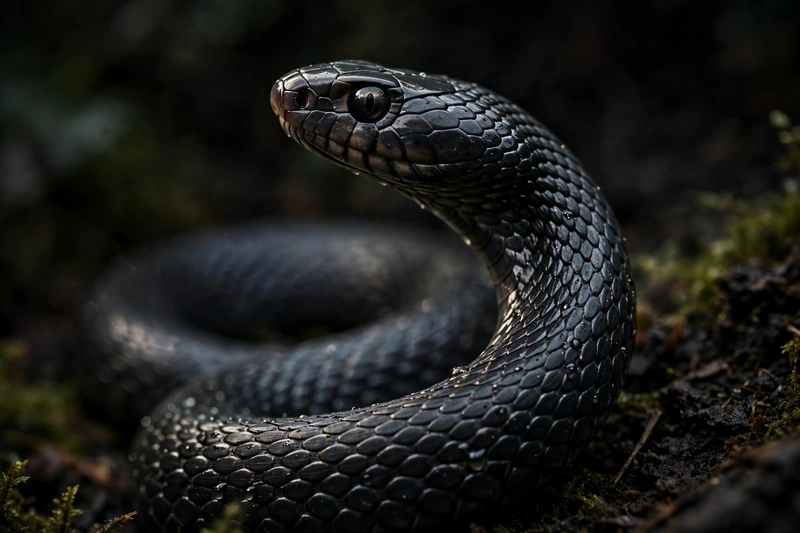
In the Islamic tradition, a snake’s color modifies its core meaning rather than replacing it: black is read as the most serious hostility, white as a weaker enemy or a trial that resolves well, and green as the most positive because of its paradisal associations in Islam. Yellow, red, and grey each add their own shade to the reading.
| Color | Common classical reading |
| Black snake | A strong, dangerous enemy; among the most negative variants |
| White snake | A weaker enemy, or hostility softened; some read it as a trial that resolves well |
| Green snake | Often the most positive: green’s paradisal associations may indicate a religious or righteous person in conflict with the dreamer, or enmity that turns to good |
| Yellow snake | Frequently connected with illness or envy in classical color symbolism |
| Red snake | Intensity: a passionate or openly aggressive enemy |
| Grey snake | An enemy of unclear nature; muted or ambiguous hostility |
These color readings draw on the broader Islamic symbolism of colors, applied to the snake’s core meaning of enmity. Color is a modifier, not the whole message, and scholarly differences exist. For every shade in full, see our snake color meanings hub.
What Should a Muslim Do After a Troubling Snake Dream?
Islamic teachings offer practical, spiritually grounded responses to bad dreams, and they are distinct from interpretation itself. The tradition’s advice is simple: seek Allah’s protection, do not spread the dream around, turn to prayer and charity, treat the dream as a prompt for reflection rather than a verdict, and consult a qualified scholar if it weighs on you.
1. Seek refuge with Allah. The well-known prophetic guidance regarding bad dreams includes seeking Allah’s protection from the dream’s evil and from Satan, and not narrating the dream to others.
2. Do not spread it. Classical etiquette discourages recounting frightening dreams broadly, to avoid unnecessary anxiety.
3. Pray and give charity. Turning to prayer, remembrance (dhikr), and charity are the tradition’s recommended responses to unease of any kind, dreams included.
4. Treat the dream as a prompt, not a verdict. A snake dream may be reason to examine your relationships and guard against genuine hostility, practically and spiritually, without tipping into paranoia.
5. Ask a qualified scholar. For a dream that weighs on you, consult someone knowledgeable and trustworthy. That is the tradition’s own advice.
Why Do Islamic Scholars Differ on Dream Interpretation?
Scholars differ because Islamic dream interpretation (ta’bir al-ru’ya) is an interpretive art, not a fixed code: Ibn Sirin, al-Nabulsi, and contemporary scholars weigh the same principles differently, lived in different contexts, and always factor in the dreamer’s personal situation. The classical manuals themselves routinely list several possible readings for a single symbol.
Be cautious of sources that present a single rigid meaning, claim prophetic authority for their interpretations, or mix Islamic terminology with fortune-telling practices the tradition rejects. Authentic Islamic dream interpretation is sober, conditional, and God-conscious. It never reads like a horoscope.
Summary
The Islamic tradition offers one of the world’s most developed systems for reading snake dreams: sober, principled, and centered on the dreamer’s reality. Be aware of hidden hostility, take heart when you overcome it, and turn to God in all cases. And remember the tradition’s first principle: the most important interpreter of your dream, after Allah, is a knowledgeable scholar who knows your circumstances.
Related: What different snake colors mean in dreams · Different types of snakes in dreams · Snake bite dream meaning
Frequently Asked Questions
Most classically, it symbolizes an enemy or hidden hostility, with size, number, color, and behavior refining the meaning. However, the dreamer’s circumstances are decisive, scholars differ on details, and ultimate knowledge belongs to Allah.
Muhammad ibn Sirin (653-729 CE) was a pious early Muslim scholar of Basra, celebrated for his skill in dream interpretation. The famous manual Muntakhab al-Kalam fi Tafsir al-Ahlam is traditionally attributed to him. His method drew on the Quran, Sunnah, Arabic language, and the dreamer’s personal condition.
Not necessarily. While the dominant reading involves enmity, many scenarios are positive: killing the snake (victory), snakes fighting each other (enemies turning on one another), or a speaking snake (unexpected benefit). Context determines the reading.
Classical readings generally treat the black snake as among the most serious variants: a strong or dangerous enemy. Some classical texts specify further, but scholars differ, and the dreamer’s situation must always be considered.
This is widely read as a positive sign: triumph over an enemy, the end of a hostility, or relief from a difficulty. Some readings add that benefit or wealth may come from the defeated adversary.
Yes. Green carries strongly positive associations in Islamic symbolism (paradise, righteousness), so a green snake is often read more favorably than other colors: possibly a religious person in conflict with the dreamer, or enmity that resolves into good.
Seek Allah’s protection, avoid narrating it widely, turn to prayer and remembrance, and consider consulting a knowledgeable scholar if it troubles you. Do not let it drive you to paranoia or to fortune-tellers.
Classical interpreters did consider the dreamer’s gender, status, and life situation relevant: the same symbol could be read differently for different people. This is one reason personal consultation matters more than generic lists.
Varyingly. Reliable ones reflect the classical principles and cite their sources; unreliable ones present rigid one-line meanings, invent prophetic attributions, or blend in non-Islamic occult practices. Cross-check with scholarly sources and be skeptical of sensational claims.
Islamic ta’bir treats dreams as potentially meaningful experiences within a God-centered worldview, interpreted through revelation-based principles. Jungian or Freudian analysis treats them as products of the psyche. The two can be interesting in parallel, a snake as both “enemy” and “shadow”, but they rest on different foundations, and this guide presents the Islamic framework on its own terms.